

Home Bar Essentials: 12 Ingredients That Unlock Dozens of Cocktails
Building a home bar can get expensive surprisingly quickly.
You buy gin for one cocktail. Then tequila for another. A recipe asks for vermouth. Another needs orange liqueur. Then bitters. Then a different syrup.
Before long, your shelf is full, but somehow you still find cocktails you cannot make.
There is a smarter way to build a home bar.
Instead of asking:
“Which bottles should I own?”
Ask:
“Which ingredients unlock the most cocktails?”
That small change turns your home bar from a collection of bottles into a system where ingredients work together.
You do not need fifty bottles.
You need the right ingredients.
Build Your Home Bar Around Possibilities
A beginner might assume that building a good home bar means buying one bottle from every major spirit category.
Gin. Vodka. Rum. Tequila. Whiskey. Brandy.
But buying bottles without thinking about how they connect can leave you with an expensive collection and surprisingly few complete recipes.
A smarter approach looks for ingredient overlap.
For example:
Gin + lime + simple syrup = Gimlet
Rum + lime + simple syrup = Daiquiri
Whiskey + lemon + simple syrup = Whiskey Sour
The same citrus and sweetener support several different spirits.
That is what makes an ingredient valuable in a home bar.
The goal is not simply to own more.
The goal is to create more possibilities from what you already own.
1. Gin
Gin is one of the most versatile bottles you can add to a home bar.
Depending on the ingredients around it, gin can become refreshing, citrus-forward, bitter, herbal or spirit-forward.
A bottle of gin can help you make drinks such as:
- Gin & Tonic
- Gimlet
- Tom Collins
- Negroni
- Martini
- Bee’s Knees
Add tonic water and you have a Gin & Tonic.
Add lime and simple syrup and you have a Gimlet.
Add Campari and sweet vermouth and you have a Negroni.
That is exactly what you want from an essential bottle: multiple possibilities from one ingredient.
2. Bourbon or Rye Whiskey
Whiskey gives your home bar access to an entirely different family of cocktails.
With only a few supporting ingredients, you can make:
- Old Fashioned
- Whiskey Sour
- Manhattan
- Boulevardier
- Whiskey Highball
Whiskey, sugar and bitters create an Old Fashioned.
Whiskey, lemon and simple syrup create a Whiskey Sour.
Whiskey, sweet vermouth and bitters create a Manhattan.
One bottle suddenly connects to several classic cocktails.
3. White Rum
White rum is another excellent foundation bottle.
It pairs especially well with citrus, sugar, cola, mint and tropical flavors.
With white rum in your bar, you can explore cocktails such as:
- Daiquiri
- Mojito
- Cuba Libre
- Rum Collins
- Rum Punch variations
Rum, lime and simple syrup create a Daiquiri.
Rum, cola and lime create a Cuba Libre.
Add mint and soda and you move toward a Mojito.
White rum becomes especially useful because many of its supporting ingredients also work with gin and tequila.
4. Tequila Blanco
One versatile bottle of blanco tequila can unlock far more than Margaritas.
It can help you make:
- Margarita
- Paloma
- Tequila Sour
- Ranch Water
- Tequila Highballs
Tequila, lime and orange liqueur create a Margarita.
Tequila, grapefruit soda and lime create a Paloma.
Again, notice the ingredient overlap.
The lime you bought for your Daiquiri can also support your Margarita, Gimlet, Mojito and Paloma.
That is how an efficient home bar grows.
5. Sweet Vermouth
Sweet vermouth is one of the most useful supporting bottles in a home bar.
It is not usually the main ingredient, but it connects beautifully with several spirits.
Sweet vermouth can help unlock:
- Manhattan
- Negroni
- Boulevardier
- Americano
- Rob Roy variations
Gin, Campari and sweet vermouth create a Negroni.
Whiskey, sweet vermouth and bitters create a Manhattan.
Whiskey, Campari and sweet vermouth create a Boulevardier.
One bottle can complete several completely different drinks.
That makes it extremely valuable shelf space.
6. Orange Liqueur
Orange liqueurs such as triple sec and Cointreau-style products appear in many classic cocktails.
They pair especially well with citrus and base spirits.
Orange liqueur can help you make:
- Margarita
- Sidecar
- Cosmopolitan
- White Lady
- Various sour-style cocktails
Tequila, lime and orange liqueur create a Margarita.
Cognac, lemon and orange liqueur create a Sidecar.
Vodka, cranberry, lime and orange liqueur move toward a Cosmopolitan.
If citrus-driven cocktails are part of your usual rotation, orange liqueur becomes extremely useful.
7. Campari or Another Bitter Aperitif
A bitter aperitif may not be the first bottle every beginner buys.
But once your bar contains gin, whiskey and sweet vermouth, it becomes a powerful connector.
Gin, Campari and sweet vermouth create a Negroni.
Whiskey, Campari and sweet vermouth create a Boulevardier.
Campari, sweet vermouth and soda create an Americano.
This demonstrates one of the most important principles of building a home bar:
The best next bottle is often the one that connects ingredients you already own.
8. Aromatic Bitters
Bitters take up almost no room and are used in very small amounts, but they can transform a drink.
Aromatic bitters are useful in:
- Old Fashioned
- Manhattan
- Champagne cocktails
- Whiskey drinks
- Many modern cocktail variations
If you already have whiskey and sweet vermouth, bitters immediately increase what you can make.
They are a perfect example of a small ingredient creating a large number of possibilities.
9. Simple Syrup
Simple syrup may be one of the highest-value ingredients in your entire bar.
And you can easily make it at home using sugar and water.
It appears in drinks such as:
- Daiquiri
- Gimlet
- Whiskey Sour
- Tom Collins
- Mojito
- Numerous sour-style cocktails
Think about the combinations:
Gin + lime + syrup.
Rum + lime + syrup.
Whiskey + lemon + syrup.
One inexpensive ingredient connects several major spirit categories.
10. Fresh Lemons
A flexible home bar needs fresh citrus.
Lemon provides acidity, freshness and balance in a huge number of cocktails.
It appears in drinks such as:
- Whiskey Sour
- Tom Collins
- Bee’s Knees
- Sidecar
- Punches
- Many modern cocktails
You do not need a refrigerator full of specialty fruit.
Lemons and limes alone cover a huge amount of cocktail territory.
11. Fresh Limes
If you could keep only one fresh cocktail ingredient available, lime would be an excellent choice.
It appears in:
- Margarita
- Daiquiri
- Gimlet
- Mojito
- Moscow Mule
- Cuba Libre
- Paloma
That is an enormous amount of usefulness from one ingredient.
It also reminds us that your home bar is not limited to bottles.
Your refrigerator and pantry are part of it too.
12. One or Two Versatile Mixers
You do not need every mixer available.
Start with the ones that work best with the spirits you enjoy.
Tonic Water
Useful for Gin & Tonic and other highball-style drinks.
Soda Water
Useful for Collins-style drinks, spritzes and highballs.
Ginger Beer
Useful for Moscow Mules and multiple rum or whiskey variations.
Cola
Useful with rum and whiskey.
The goal is not to keep every possible mixer.
It is to choose mixers that connect naturally to your existing shelf.
A Simple Home Bar Checklist
A practical starter shelf might look like this:
Core Spirits
- Gin
- Bourbon or Rye
- White Rum
- Blanco Tequila
Cocktail Multipliers
- Sweet Vermouth
- Orange Liqueur
- Campari or another bitter aperitif
- Aromatic Bitters
Fresh and Pantry Ingredients
- Simple Syrup
- Lemons
- Limes
- One or two mixers
That relatively small collection can already support a surprisingly large number of cocktails.
What Can This Shelf Actually Make?
The value of a home bar becomes clearer when you stop looking at ingredients individually and start looking at combinations.
With the ingredients above, you could make or closely approach drinks such as:
Gin & Tonic
Gin + Tonic
Gimlet
Gin + Lime + Simple Syrup
Tom Collins
Gin + Lemon + Simple Syrup + Soda
Negroni
Gin + Campari + Sweet Vermouth
Old Fashioned
Whiskey + Simple Syrup + Bitters
Whiskey Sour
Whiskey + Lemon + Simple Syrup
Manhattan
Whiskey + Sweet Vermouth + Bitters
Boulevardier
Whiskey + Campari + Sweet Vermouth
Daiquiri
Rum + Lime + Simple Syrup
Cuba Libre
Rum + Cola + Lime
Margarita
Tequila + Lime + Orange Liqueur
Americano
Campari + Sweet Vermouth + Soda
Now your shelf is no longer a group of unrelated bottles.
It becomes a network of cocktail possibilities.
The Best Home Bar Is Not the Biggest One
A shelf containing forty bottles may look impressive.
But if most of those bottles rarely work together, the collection may not be particularly useful.
A smaller bar can be much more effective when its ingredients connect.
Think of your shelf as a system.
One ingredient works with several others.
Those ingredients connect to several recipes.
Adding one new bottle may suddenly unlock four or five more cocktails.
That is a much smarter way to build a home bar than simply collecting bottles.
Ask a Better Question Before Buying Your Next Bottle
Before buying something new, do not only ask:
“Do I like this bottle?”
Also ask:
“How many new cocktails will this let me make with the ingredients I already own?”
Imagine your shelf already contains:
- Gin
- Whiskey
- Campari
- Bitters
- Lemon
- Lime
- Simple Syrup
Now you are choosing your next bottle.
Buying sweet vermouth could connect directly to several ingredients already on your shelf.
Suddenly you may unlock:
- Negroni
- Manhattan
- Boulevardier
- Americano
That is a much more strategic purchase than buying a bottle that only appears in one recipe you happened to see online.
This Is Where Pourista Makes Your Home Bar Smarter
Keeping track of all these combinations is easy when your bar contains only five ingredients.
It becomes much harder when your collection grows to twenty, thirty or forty.
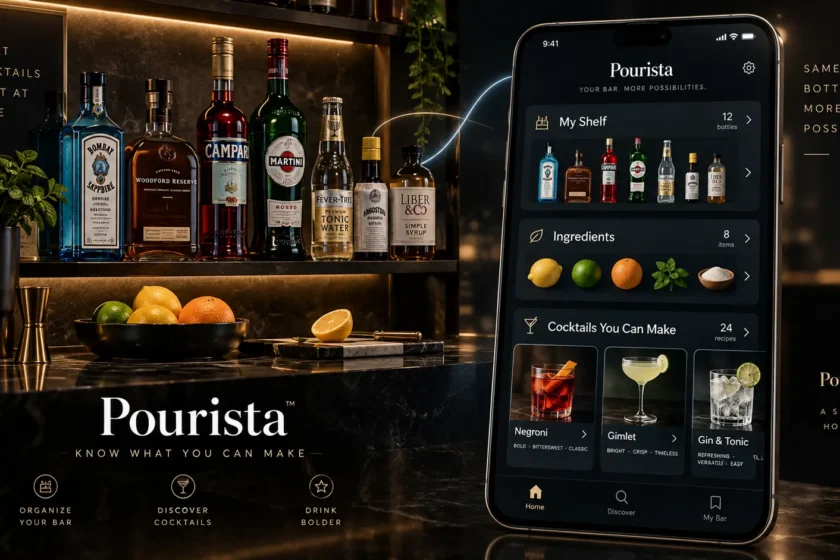
That is where Pourista can help.
Instead of trying to remember everything on your shelf, you can store your ingredients digitally.
Your Pourista shelf might contain:
- Gin
- Bourbon
- White Rum
- Campari
- Sweet Vermouth
- Orange Liqueur
- Aromatic Bitters
- Lime
- Lemon
- Simple Syrup
- Tonic Water
Now your bar is not only physical.
It also exists as organized data.
And once your ingredients are stored, they can connect to cocktail recipes.
Instead of manually searching through hundreds of drinks and checking each ingredient yourself, you can focus on cocktails that make sense for your actual shelf.
What Can I Make Right Now?
This is one of the most useful questions a home bar can answer.
If Pourista knows which ingredients you have, your shelf can help surface drinks that already fit your collection.
You may discover that you can make:
- Negroni
- Gimlet
- Old Fashioned
- Daiquiri
- Whiskey Sour
- Gin & Tonic
without buying anything else.
That changes the way you discover cocktails.
Instead of starting from thousands of recipes, you start from your own ingredients.
What Should I Buy Next?
Your shelf can also help you think more strategically about the future.
Suppose one missing bottle would complete several cocktails.
That ingredient becomes much more useful than something that only unlocks one recipe.
This is where organizing your home bar digitally becomes more than simple inventory management.
Your shelf can become a tool for making better decisions.
Build Around Your Taste
No home bar checklist is perfect for everyone.
If you dislike tequila, there is no reason to buy tequila simply because someone calls it essential.
If you love whiskey cocktails, your ideal shelf may focus more heavily on:
- Bourbon
- Rye
- Sweet Vermouth
- Bitters
- Campari
If you prefer refreshing gin drinks, your shelf may prioritize:
- Gin
- Tonic
- Soda
- Lemon
- Lime
- Simple Syrup
- Vermouth
The best home bar is the one built around the drinks you actually enjoy.
That is also why a personal digital shelf is useful.
It represents your bar, not someone else’s idea of the perfect one.
Start Small and Make More
You do not need a professional back bar to make excellent cocktails at home.
Start with ingredients that work together.
Choose bottles that unlock multiple recipes.
Add new ingredients when they meaningfully expand your options.
And keep track of what you actually own.
The goal is not:
More bottles.
The goal is:
More possibilities from the bottles you already have.
With Pourista, your shelf becomes more than a collection.
Store your ingredients.
Understand what they unlock.
Discover your next cocktail.
Pourista — Elevate Every Pour.